
A smarter way to source capex purchases.
Krinati helps large manufacturing organisations address capex spend across plant and machinery, IT infrastructure, construction and facility fit-out - running competitive RFPs and live reverse auctions across lots and line items, then comparing suppliers on landed cost before you award.
Four problems every capex buyer runs into.
Krinati helps you handle all four: bring competitive pricing to categories with no price history, qualify suppliers on spec before price enters the picture, compare bids on landed cost instead of the headline quote, and keep a ceiling price working for you after the RFP closes.
Plant and machinery, construction, IT infrastructure, electrical and material handling - every category where specification, not just price, decides who gets to compete.
No price history
You buy a line of machinery once in years. The last quote is stale, and the supplier knows you have nothing to benchmark against.
Spec comes before price
Technical fit decides who is allowed to bid at all. Price only matters among suppliers who clear that bar.
The quote isn't the cost
Freight, duties, installation, commissioning and spares all move the real number. A low quote can be the expensive one.
Leverage ends at the PO
Once the order is placed, the negotiation is over. Approvers also need a clear, comparable basis for the award.
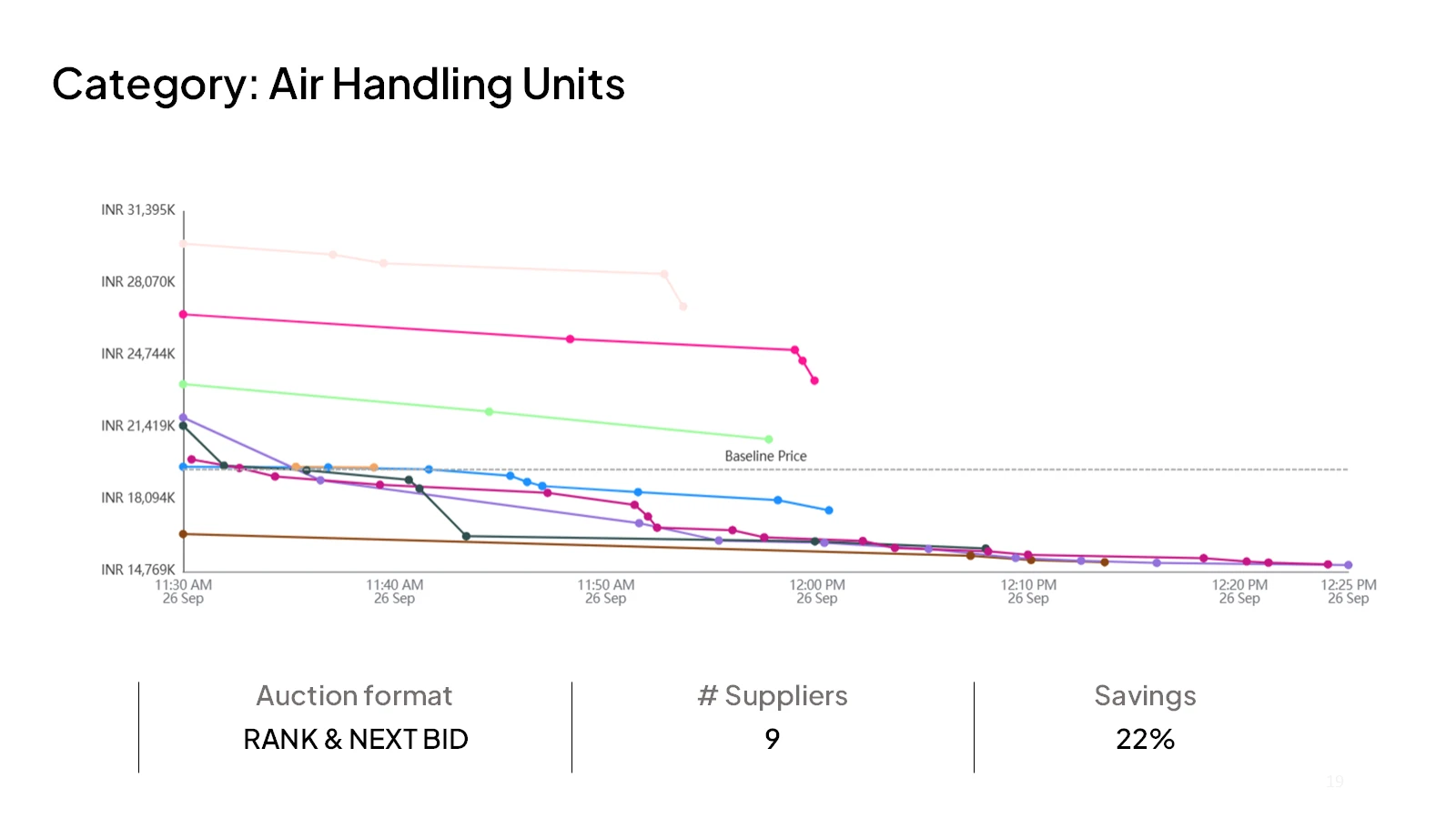
Nine suppliers, one lot, 22% off baseline.
Air Handling Units - nine qualified suppliers, Rank + Next Bid feedback, run as a live reverse auction on the Krinati platform. Every bid below is timestamped and was held in a full audit trail.
From scope to award, in the order a capex project actually moves.
Scope and classify
Break the project into lots and line items. Map lots with supplier capability to compare coverage across projects and plants.
Qualify suppliers
Run an RFI and pre-qualification criteria first. Only suppliers who clear your technical and commercial bar move to the next stage.
Collect proposals
Issue an RFQ or RFP and receive technical and commercial responses in one structured place, ready to evaluate side by side.
Run the reverse auction
Qualified suppliers bid live against each other. Set a ceiling price per supplier, pick how much each bidder sees, and choose the auction format that fits the category.
Compare landed cost and award
Configure the auction on Krinati to map landed cost parameters against each bid placed by the supplier. While suppliers place price bids, they are transformed into landed cost as perceived by buyer.
The controls a capex negotiation actually needs.
Supplier-specific ceiling price
Cap each supplier at their own number, not one price for everyone - useful when incumbents, new entrants and regional suppliers start from very different places.
Seven feedback modes
Decide how much each bidder learns about their rank and the competition while the auction is live. Match the mode to how competitive the market really is.
Lots and line items at scale
Up to 200 lots and 5,000 line items in a single event, with 60+ suppliers bidding concurrently. One event can cover a whole project package.
Flexible auction formats
Reverse, forward, Dutch and Japanese auctions, plus RFI, RFQ and RFP - so the event format follows the buy, not the other way round.
Landed cost analysis
Compare suppliers on what the asset really costs to get on site and running, so the lowest bid and the lowest cost are never confused.
Secure, enterprise-ready
ISO 27001 certified, hosted on AWS, with a 99.5% uptime SLA. Your project specs and supplier prices stay protected.
Every mode and format above is part of Krinati's core auction engine - see the full breakdown on the reverse auctions page →.
Any capital purchase with a defined scope and competing suppliers.
Questions capex teams ask first.
Can we run a reverse auction when price is not the only factor?
Yes - that is usually the case for capex auctions which are brand specific, say two suppliers aren't the same on technical evaluation. Both qualify but one is better than the other. For such scenarios, Krinati allows multi-attribute bid transformation that can assign weights to bids placed by suppliers and transform them in real time.
Will suppliers see each other's names or prices?
That is the buyer's call. Krinati supports seven feedback modes that control how much each bidder sees about their rank and the competition. Relevant to capex purchases, there is a traffic light feedback option which can be used to shortlist suppliers for a final face-to-face negotiation.
How do you compare suppliers once freight, duties and installation are added?
Easily done. Krinati allows the buyer to configure the pricing sheet to include all price terms including base price, packing, freight, installation, taxes, etc. Bidders enter all elements of the quote and not just an overall quote. Bids can be uploaded from or copied and pasted from an excel sheet during live bidding.
Do we need our own sourcing team to use it?
You can use the platform yourself, or ask Krinati's managed services team to run events for you on your dedicated sourcing instance.