
A smarter way to source indirect spend.
Krinati helps large manufacturing organisations consolidate indirect spend across services, MRO, logistics and admin categories - running competitive RFQs and live reverse auctions across lots and line items, so tail spend stops auto-renewing and starts competing like every other category you buy.
Four problems every indirect buyer runs into.
Krinati helps you handle all four: put an owner and a process behind spend that falls between departments, bring expiring AMCs and service contracts back to competitive bidding instead of letting them roll over, qualify vendors on service level before price enters the picture, and combine dozens of small-ticket categories into events big enough to earn real leverage.
AMCs, housekeeping, logistics, MRO, packaging and stationery - every category where volume is split across departments and no one has ever run a competitive process.
Decentralized purchasing
Departments and plant managers buy independently, sometimes outside procurement's preferred process.
Contracts renew, they don't get rebid
AMCs, insurance, housekeeping and courier contracts roll over on the same terms year after year because re-tendering a small-ticket category rarely feels worth the effort.
Price isn't the only variable
Service levels, response times, manpower deployment and quality standards matter as much as the rate card - a lower quote on paper can mean a worse vendor on the floor.
Too many categories, too little leverage
Sixteen-plus categories and hundreds of small purchase orders, with no consolidated view of who's buying what from whom - so volume that could earn a discount never gets combined.
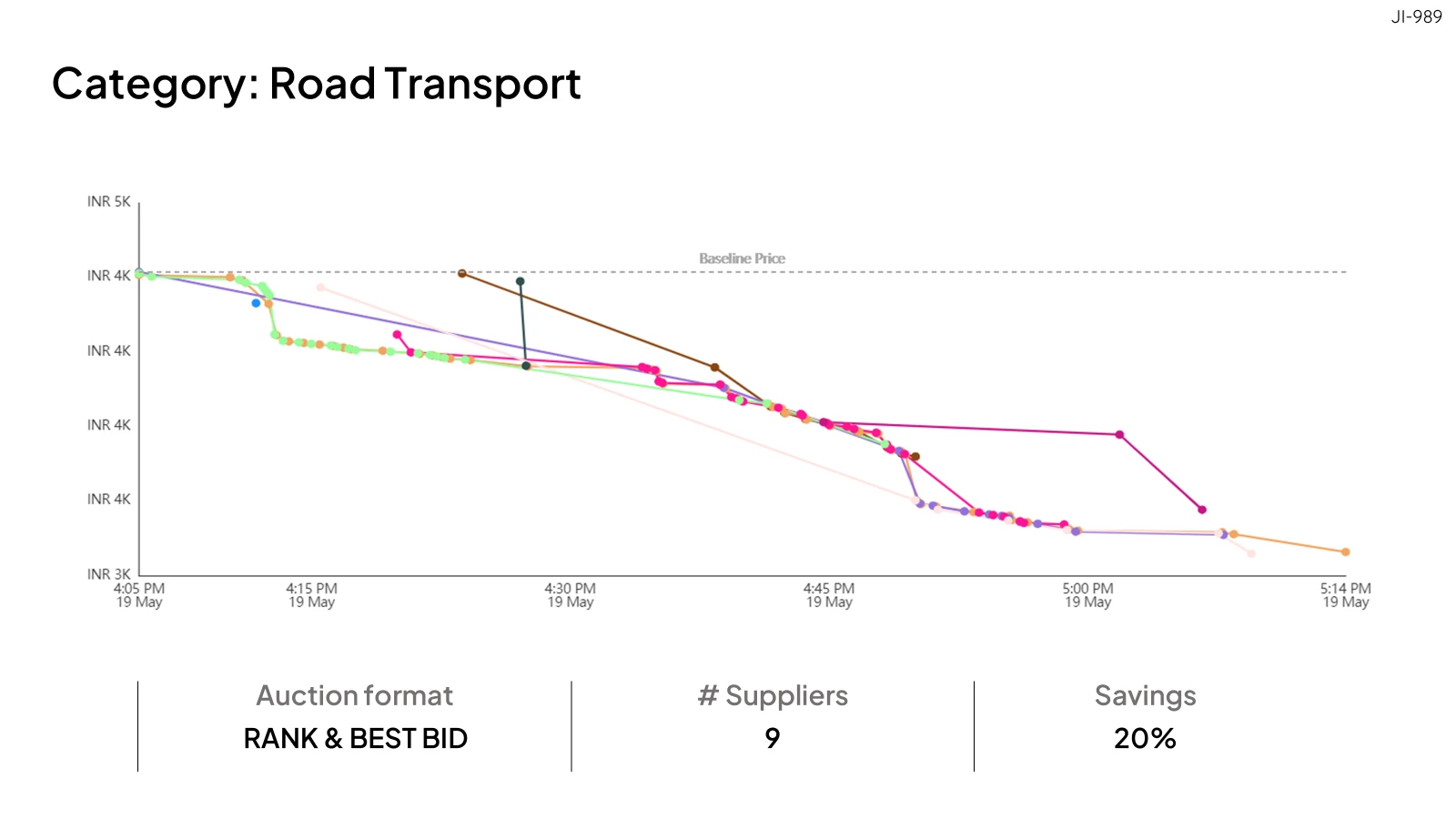
Nine transporters, one lot, 20% off baseline.
Road Transport - nine qualified transporters, Rank & Best Bid feedback, run as a live reverse auction on the Krinati platform. Every bid below is timestamped and was held in a full audit trail.
From scope to award, without a dozen separate spreadsheets.
Scope and classify
Group indirect spend into categories and lots - AMCs, housekeeping, logistics, MRO - so similar buys are rebid together instead of renewed one PO at a time.
Qualify suppliers
Empanel vendors against service-level and compliance criteria first, especially for categories where quality and manpower matter as much as price.
Collect proposals
Issue RFQs or RFPs across categories in one structured workflow, so facilities, admin and plant teams aren't each running their own spreadsheet.
Run the reverse auction
Qualified vendors bid live against each other, lot by lot, with a ceiling price and the feedback mode that fits how competitive the category is.
Compare and award
See savings against baseline in real time and award with a full audit trail your approvers and auditors can rely on.
The controls an indirect sourcing programme actually needs.
Supplier-specific ceiling price
Cap each vendor at their own number - useful when an incumbent AMC vendor and a new entrant start from very different rates.
Seven feedback modes
Decide how much each bidder learns about their rank and the competition while the auction is live. Match the mode to how commoditized the category is.
Lots and line items at scale
Up to 200 lots and 5,000 line items in a single event - enough to cover stationery, packaging and MRO items without running a dozen separate auctions.
Flexible auction formats
Reverse, forward, Dutch and Japanese auctions, plus RFI, RFQ and RFP - so a one-time insurance renewal and a recurring housekeeping contract don't have to run the same way.
Category-wide spend visibility
Roll up every indirect category into one dashboard, so tail spend stops hiding across a hundred small purchase orders.
Secure, enterprise-ready
ISO 27001 certified, hosted on AWS, with a 99.5% uptime SLA. Vendor rates and service terms stay protected.
Every mode and format above is part of Krinati's core auction engine - see the full breakdown on the reverse auctions page →.
Any recurring or one-off indirect category with a defined scope and competing vendors.
Questions indirect sourcing teams ask first.
Is a reverse auction even the right tool for services like housekeeping or pest control, where quality matters as much as price?
Yes - qualify first. Krinati runs an RFI and pre-qualification stage so only vendors who clear your service-level and compliance bar are invited to bid. Price then decides among equals, not instead of them.
Our indirect spend is spread across a dozen categories with just a few suppliers each - is that too small for an auction?
No spend is too small for a reverse auction. The spend needs to be negotiated anyway, so rather than spending manual effort on a small spend, the best way would be to automate it with a reverse auction.
Are there any costs for suppliers to participate?
No. Suppliers participate at no cost. There are no subscription fees, transaction fees, or platform charges for suppliers. Krinati's model is buyer-side only.
Indirect spend comprises of dozens of categories. Wouldn't it be expensive to do hundreds of auctions on a reverse auction platform?
Not at all. Krinati's customers do thousands of auctions each year for a very nominal annual subscription fee.