
Top 10 Supplier Evaluation Criteria, With a Scorecard Example
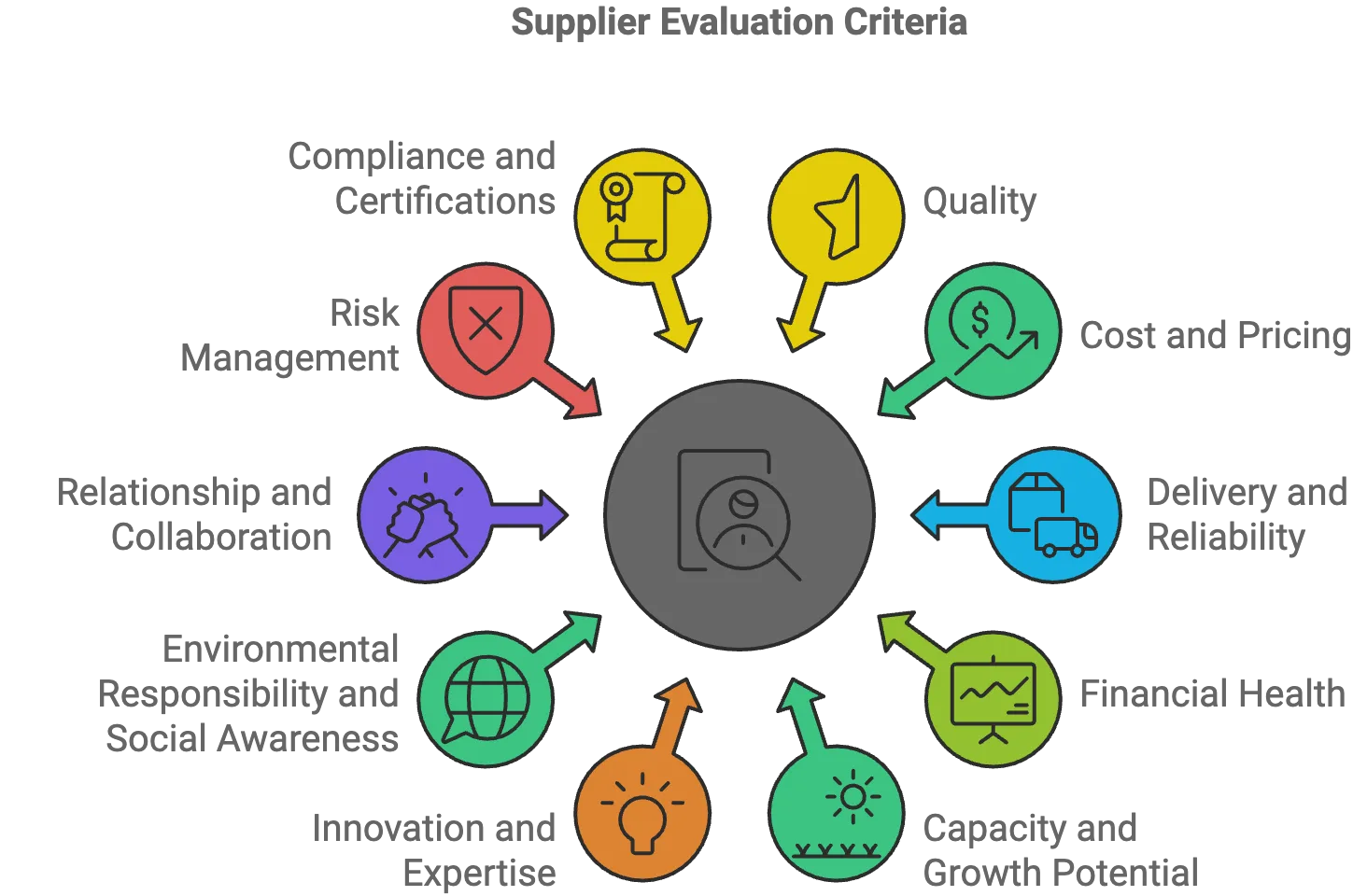
Supplier evaluation criteria are the measures you use to compare suppliers and decide which ones to approve or award business to. Using the same criteria for every supplier makes the decision fair and easier to explain.
Short answer. The 10 common supplier evaluation criteria are quality, cost, delivery, financial health, capacity, innovation, environmental and social responsibility, relationship, risk, and compliance. To use them, reject suppliers who fail any must-have requirement, give the remaining criteria weights that add up to 100, and score each supplier using evidence.
The 10 criteria at a glance
| Criterion | The question to ask | Proof to ask for |
|---|---|---|
| Quality | Will the supplier meet our specification every time? | Certificates, rejection rates, samples |
| Cost and pricing | What will this cost us in total? | Itemised quote, payment and freight terms |
| Delivery and reliability | Will orders arrive on time and in full? | On-time delivery records, customer references |
| Financial health | Will the supplier stay in business? | Audited financial statements, credit report |
| Capacity and growth potential | Can the supplier handle our volumes? | Capacity figures, current workload |
| Innovation and expertise | Can the supplier help us improve? | Past examples, technical team details |
| Environmental and social responsibility | Does the supplier treat people and the environment properly? | Policies, certificates, site visit |
| Relationship and collaboration | Is the supplier easy to work with? | Response times, customer references |
| Risk management | What happens if something goes wrong? | Backup plans, list of key sub-suppliers |
| Compliance and certifications | Does the supplier meet legal and industry rules? | Registrations, licences, certificates |
1. Quality
Poor quality leads to rejected material, production delays and complaints from your customers. Check:
- Quality certifications, such as ISO 9001
- Rejection and return rates from recent orders
- How the supplier inspects its products before dispatch
- Compliance with the standards for your industry
A certificate shows that a quality system exists. It does not show how good the products are, so ask for samples or recent rejection data too.
2. Cost and pricing
The lowest quote is not always the lowest cost. Compare the total cost of ownership, which includes everything you will pay over the life of the purchase:
- Unit price and how it may change over time
- Freight, packing, taxes and installation
- Payment terms
- Maintenance, spares and the cost of rejected material
3. Delivery and reliability
Late or short deliveries can stop your production or service. Check:
- The percentage of orders delivered on time and in full
- Normal lead times
- How the supplier handles urgent orders
- How the supplier handles sudden changes in volume
4. Financial health
A supplier in financial trouble may delay orders, cut corners or close down. Check:
- Audited financial statements for the last three years
- Credit reports and payment history
- Trends in revenue and profit
- Debt levels
Pay more attention to this criterion when you depend on one supplier or are paying large advances.
5. Capacity and growth potential
A supplier may be able to deliver a trial order but not your full monthly volume. Check:
- Total production capacity and how much is already in use
- Ability to increase output when demand rises
- Investment in new equipment and technology
- Plans to expand
6. Innovation and expertise
This matters most when you want a supplier to help you improve a product or reduce its cost. Look for:
- Technical skills and experience in your industry
- Investment in research and development
- Past examples of new products or better processes
- Willingness to work with your team on new products
7. Environmental and social responsibility
Problems at a supplier’s site can damage your company’s reputation and create legal risk. Check:
- Environmental policies and certificates, such as ISO 14001
- Compliance with labour laws, including wages, working hours and safety
- Rules against child labour and forced labour
- How the supplier checks its own sub-suppliers
8. Relationship and collaboration
A supplier that communicates well will tell you about a problem early, while you can still act on it. Consider:
- How quickly and clearly the supplier responds
- Willingness to share information
- How the supplier handled problems with other customers
- Feedback from customer references
9. Risk management
Every supplier can face a fire, a strike, a shortage or a cyber attack. What matters is how well it is prepared. Assess:
- Backup plans for key sites and equipment
- Dependence on one raw material or sub-supplier
- Risks linked to the supplier’s location
- Data protection and cybersecurity, if the supplier handles your data
10. Compliance and certifications
A supplier that breaks the law can create legal and financial problems for your company. Look for:
- Valid business and tax registrations, such as GST in India
- Licences and certificates required for your industry
- Data protection compliance, such as GDPR if it applies
- Any record of penalties or legal cases
How to score suppliers: a scorecard example
A scorecard turns these criteria into a number you can compare across suppliers. There are five steps.
- Set your must-haves. These are pass or fail, such as a required licence or certificate. Reject any supplier who fails, however good its price.
- Choose your criteria. Pick the ones that matter for this purchase. You do not have to use all 10.
- Set the weights. Give each criterion a share of 100 points. Agree this before you see any quotes.
- Score each supplier. Use a scale of 1 to 5, where 1 means below your requirement, 3 means it meets your requirement and 5 means it clearly exceeds it. Base each score on evidence.
- Calculate the total. Multiply each score by its weight, add the results and divide by 5. This gives a score out of 100.
Here is an example with three suppliers. The weights and scores are made up to show how the calculation works. They are not recommended values, and six criteria are used here to keep the example short.
| Criterion | Weight | Supplier A | Supplier B | Supplier C |
|---|---|---|---|---|
| Quality | 25 | 4 | 3 | 5 |
| Cost and pricing | 25 | 3 | 5 | 2 |
| Delivery and reliability | 20 | 4 | 3 | 5 |
| Financial health | 10 | 3 | 4 | 4 |
| Capacity | 10 | 4 | 3 | 5 |
| Risk and compliance | 10 | 4 | 3 | 5 |
| Total out of 100 | 100 | 73 | 72 | 83 |
For Supplier A, the calculation is (25×4 + 25×3 + 20×4 + 10×3 + 10×4 + 10×4) ÷ 5 = 73.
Supplier B has the best price score but finishes last. Supplier C has the weakest price score but the highest total. This does not mean you must choose Supplier C. It shows you what you would get for the higher price, and gives you a reason to negotiate with Supplier C on price.
Which criteria should get the most weight?
It depends on what you are buying and what would happen if the supplier failed. As a starting point:
| What you are buying | Give more weight to |
|---|---|
| Critical production material | Quality, delivery and risk |
| Standard items with many suppliers | Cost and delivery |
| Capital equipment | Technical expertise, total cost and after-sales support |
| Services | Expertise, relationship and compliance |
| Items from a single source | Financial health and risk |
Common mistakes to avoid
- Scoring without evidence. Ask for records and speak to customer references. Do not rely on the supplier’s sales presentation.
- Letting one person do all the scoring. Ask purchasing, quality, finance and the user department to score the criteria they know best.
- Scoring after seeing prices. A low price can influence how people score everything else. Score quality and technical criteria first.
- Changing the weights later. If you change the weights after seeing the scores, the process is no longer fair.
- Evaluating once and stopping. Keep checking approved suppliers using their actual delivery and quality records. Our guide to supplier performance management explains how.
What to do after the evaluation
Once you have a list of qualified suppliers, ask them to compete for your business through an RFQ or a reverse auction. Because all of them have already met your requirements, you can focus on commercial terms. You can also read about other supplier evaluation methods, such as audits and reference checks, or see how to manage suppliers after you have selected them.
Frequently asked questions about supplier evaluation criteria
What are supplier evaluation criteria?
They are the measures you use to compare suppliers and decide which ones to approve or award business to. Common examples are quality, cost, delivery, financial health and compliance.
What are the 5 key supplier evaluation criteria?
Most evaluations start with quality, cost, delivery, financial health and capacity. Add other criteria, such as risk or compliance, based on what you are buying.
What is the difference between supplier evaluation and supplier selection?
Supplier evaluation means assessing a supplier against your criteria. Supplier selection is the decision about which supplier to use. You evaluate suppliers first, and then use the results to select one.
How do you weight supplier evaluation criteria?
Give each criterion a share of 100 points based on how much it matters for this purchase. Agree the weights with the teams involved before you see any supplier's quote or score.
How often should you evaluate existing suppliers?
We suggest reviewing critical suppliers at least once a year and other active suppliers less often. Review a supplier sooner if there is a serious quality or delivery problem.