
Supplier Segmentation
Key Takeaways
| Focus Area | Takeaway |
|---|---|
| Definition | Supplier segmentation groups vendors based on spend, risk, and strategic importance |
| Framework | The Kraljic Matrix is an effective tool for advanced supplier segmentation |
| Benefits | Proper segmentation improves supplier relationships and reduces risks |
| Data | Data-driven analysis is essential for accurate supplier categorization |
| Segment Strategies | Customized strategies for each segment optimize procurement resources and efficiency |
Introduction to Supplier Segmentation
Definition of supplier segmentation
Supplier segmentation is a strategic process that involves categorizing suppliers based on specific criteria, allowing organizations to manage their supplier relationships more effectively. This approach recognizes that suppliers vary in their value, risk, or strategic importance to a company.
Importance of supplier segmentation for procurement and supply chain management
In procurement and supply chain management, supplier segmentation plays a key role in optimizing operations. By classifying suppliers into distinct groups, organizations can:
- Allocate resources more efficiently
- Tailor their approach to each supplier category
- Identify and nurture strategic partnerships
- Reduce potential risks in the supply chain
Overview of key benefits
Implementing a robust supplier segmentation strategy offers several advantages:
- Better supplier relationships: By understanding the strategic importance of each supplier, companies can foster stronger partnerships with key vendors.
- Enhanced risk management: Identifying high-risk suppliers allows for proactive risk reduction strategies.
- Increased operational efficiency: Focusing resources on the most critical suppliers leads to streamlined processes and cost savings.
- Improved negotiation outcomes: Segmentation provides insights that can be leveraged during contract negotiations.
- Strategic alignment: Aligning supplier management with overall business objectives becomes more achievable.
Types of Supplier Segmentation
Spend-based segmentation
Spend-based segmentation is a basic approach that categorizes suppliers based on the total amount of money an organization spends with them. This method aligns with the Pareto Principle, also known as the 80/20 rule, which suggests that approximately 20% of suppliers often account for 80% of an organization’s total spend.
Categorizing suppliers by total spend
To implement spend-based segmentation:
- Analyze historical spend data for all suppliers
- Rank suppliers from highest to lowest spend
- Group suppliers into categories (e.g., high, medium, low spend)
Considering forecasted spend growth
It’s important to not only look at current spend but also consider potential future growth:
- Evaluate suppliers with increasing spend trends
- Identify emerging vendors that may become strategically important
Risk-based segmentation
Risk-based segmentation focuses on assessing the potential threats that suppliers pose to an organization’s operations and reputation.
Assessing supplier risks (internal and external threats)
When evaluating supplier risks, consider:
- Financial stability
- Geopolitical factors
- Compliance with regulations
- Environmental and social responsibility
- Supply chain disruptions
Classifying suppliers into low, medium and high risk categories
After assessing risks, categorize suppliers accordingly:
- Low-risk: Suppliers with minimal potential for disruption
- Medium-risk: Vendors that require regular monitoring
- High-risk: Critical suppliers that need close management and contingency plans
By utilizing these segmentation methods, organizations can gain a comprehensive understanding of their supplier base and develop targeted strategies for each category.
Kraljic Matrix
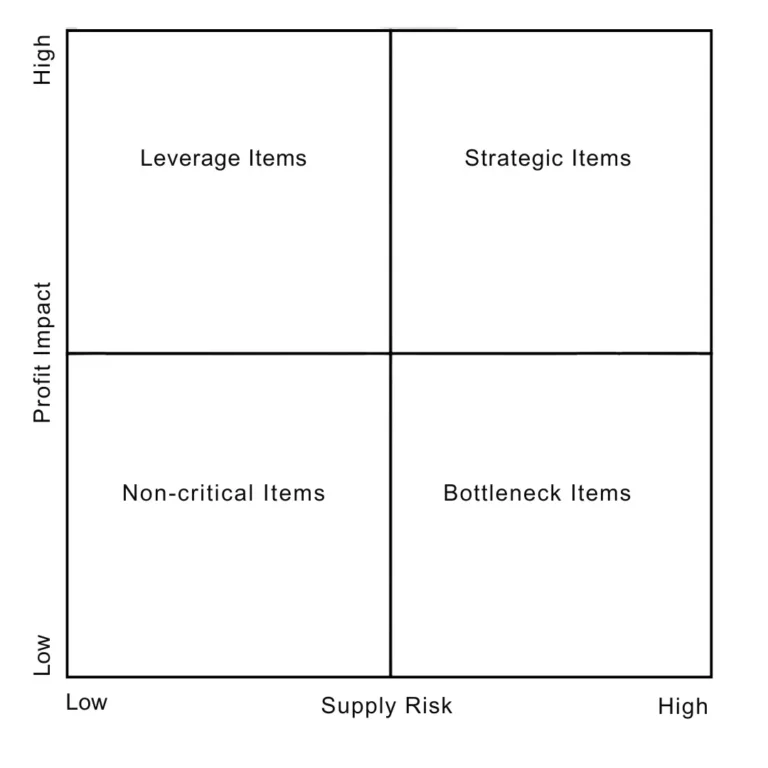
The Kraljic Matrix is a sophisticated tool for supplier segmentation, plotting suppliers on a 2x2 matrix based on two key dimensions: supply risk and profit impact.
Plotting suppliers on a 2x2 matrix based on value and spend
To use the Kraljic Matrix:
- Assess each supplier’s profit impact (typically related to spend)
- Evaluate the supply risk associated with each vendor
- Plot suppliers on the matrix according to these two factors
Quadrants: Non-critical, Bottleneck, Leveraged, Strategic
The Kraljic Matrix divides suppliers into four quadrants:
- Non-critical (Low value, Low risk): Routine suppliers that require minimal management
- Bottleneck (Low value, High risk): Suppliers of specialized products that may pose operational risks
- Leveraged (High value, Low risk): Suppliers of high-value items with multiple alternatives available
- Strategic (High value, High risk): Critical suppliers that require close collaboration and partnership
How to Perform Supplier Segmentation
Effective supplier segmentation requires a systematic approach. Let’s explore the steps to implement this strategic process in your organization.
Gather necessary data
The foundation of successful supplier segmentation lies in collecting comprehensive and accurate data. Key information to gather includes:
Spend data
- Total annual spend with each supplier
- Spend trends over time
- Spend by category or department
Supplier characteristics
- Uniqueness of offering
- Innovation capabilities
- Level of collaboration and partnership
Supplier risk factors
- Financial stability
- Geopolitical risks
- Compliance history
- Environmental and social responsibility scores
Impact on customers
- Quality of goods or services provided
- Timeliness of deliveries
- Customer satisfaction scores related to supplier performance
Analyze data and categorize suppliers
Once you have gathered the necessary data, the next step is to analyze it and categorize your suppliers accordingly.
Assign priority levels (e.g. Priority 1, 2, 3) based on criticality
- Develop a scoring system that weighs different factors (e.g., spend, risk, strategic importance)
- Apply the scoring system to each supplier
- Group suppliers into priority levels based on their scores
Use Kraljic Matrix for more advanced segmentation
For a more nuanced approach, plot your suppliers on the Kraljic Matrix:
- Assess each supplier’s profit impact and supply risk
- Place suppliers in the appropriate quadrant (Non-critical, Bottleneck, Leveraged, Strategic)
- Validate the placement with key stakeholders in your organization
Develop tailored strategies for each segment
With suppliers categorized, it’s time to create targeted strategies for each segment.
Prioritize strategic relationships
For strategic suppliers:
- Establish executive-level relationships
- Collaborate on innovation and long-term planning
- Implement regular performance reviews and continuous improvement initiatives
Manage performance of important suppliers
For leveraged and bottleneck suppliers:
- Set clear performance expectations
- Conduct regular supplier evaluations
- Develop risk mitigation strategies for bottleneck suppliers
Monitor compliance for low-risk suppliers
For non-critical suppliers:
- Implement automated monitoring systems
- Focus on efficiency and cost reduction
- Consider consolidation or standardization opportunities
By following these steps, you can create a robust supplier segmentation framework that aligns with your organization’s goals and optimizes your procurement processes.
Benefits of Effective Supplier Segmentation
Implementing a well-structured supplier segmentation strategy can yield significant advantages for your organization. Let’s explore the key benefits in detail.
Improved supplier relationships
Effective segmentation allows you to:
- Focus attention on strategic partners
- Tailor communication and engagement strategies
- Build stronger, more collaborative relationships with key suppliers
This targeted approach can lead to:
- Increased trust and transparency
- Joint innovation initiatives
- Better alignment of goals between your organization and critical suppliers
Reduced supplier risk
By categorizing suppliers based on risk factors, you can:
- Identify potential vulnerabilities in your supply chain
- Implement proactive risk mitigation strategies
- Develop contingency plans for high-risk suppliers
This proactive stance helps:
- Minimize supply chain disruptions
- Protect your organization’s reputation
- Ensure business continuity
Greater supply chain efficiency
Supplier segmentation enables:
- Streamlined processes for different supplier categories
- Optimized resource allocation
- Focused improvement initiatives
These efficiencies can result in:
- Reduced operational costs
- Improved supply chain responsiveness
- Enhanced overall performance
Better allocation of procurement resources
With a clear understanding of supplier segments, you can:
- Direct more resources to managing strategic suppliers
- Automate processes for low-risk, non-critical suppliers
- Balance efforts across your supplier portfolio
This strategic allocation leads to:
- More effective use of procurement team time and expertise
- Improved ROI on supplier management activities
Ability to deploy bespoke supplier management strategies
Segmentation allows for:
- Customized approaches for each supplier category
- Tailored performance metrics and KPIs
- Specific development plans for different supplier types
By implementing bespoke strategies, you can:
- Maximize value from each supplier segment
- Drive continuous improvement across your supply base
- Align supplier management with overall business objectives
Conclusion
Supplier segmentation is a powerful tool that can transform your procurement and supply chain management practices. By strategically categorizing suppliers based on spend, risk, and strategic importance, organizations can unlock significant value and drive operational excellence.
Throughout this article, we’ve explored the various aspects of supplier segmentation, from its fundamental principles to advanced techniques like the Kraljic Matrix. We’ve seen how effective segmentation can lead to improved supplier relationships, reduced risks, enhanced efficiency, and optimized resource allocation.
As procurement continues to evolve in an increasingly complex business landscape, the ability to segment and manage suppliers effectively will be a key differentiator for successful organizations. By implementing the strategies and best practices outlined in this article, you can position your company for success in the competitive world of procurement and supply chain management.
Ready to take your supplier management to the next level? Krinati Solutions offers cutting-edge eSourcing and eProcurement solutions that can help you implement robust supplier segmentation strategies. Our advanced supplier management tools are designed to streamline your processes and drive value across your supply chain.
Don’t let the complexities of supplier management hold your organization back. Contact Krinati Solutions today to learn how our innovative solutions can help you harness the power of effective supplier segmentation and transform your procurement operations.