
Mastering Your Auction Strategy: English vs. Dutch Reverse Auctions
Reverse Auctions are growing in acceptance among procurement teams
In the world of strategic sourcing, reverse auctions have become a common tool for procurement departments looking to negotiate with a set of qualified suppliers. Unlike a traditional form of negotiation where back and forth communication happens between buyers & suppliers, a reverse auction involves vendors competing to sell their goods or services on an online platform.
The most common form of reverse auction is the English format. A Dutch auction can also be the more effective choice in specific situations. Selecting the appropriate format is therefore a core part of an effective auction strategy that balances cost, quality, and supplier relationships.
English Reverse Auctions: The “Race to the Bottom”
The English reverse auction is the most frequently used format in the procurement industry.
How it Works
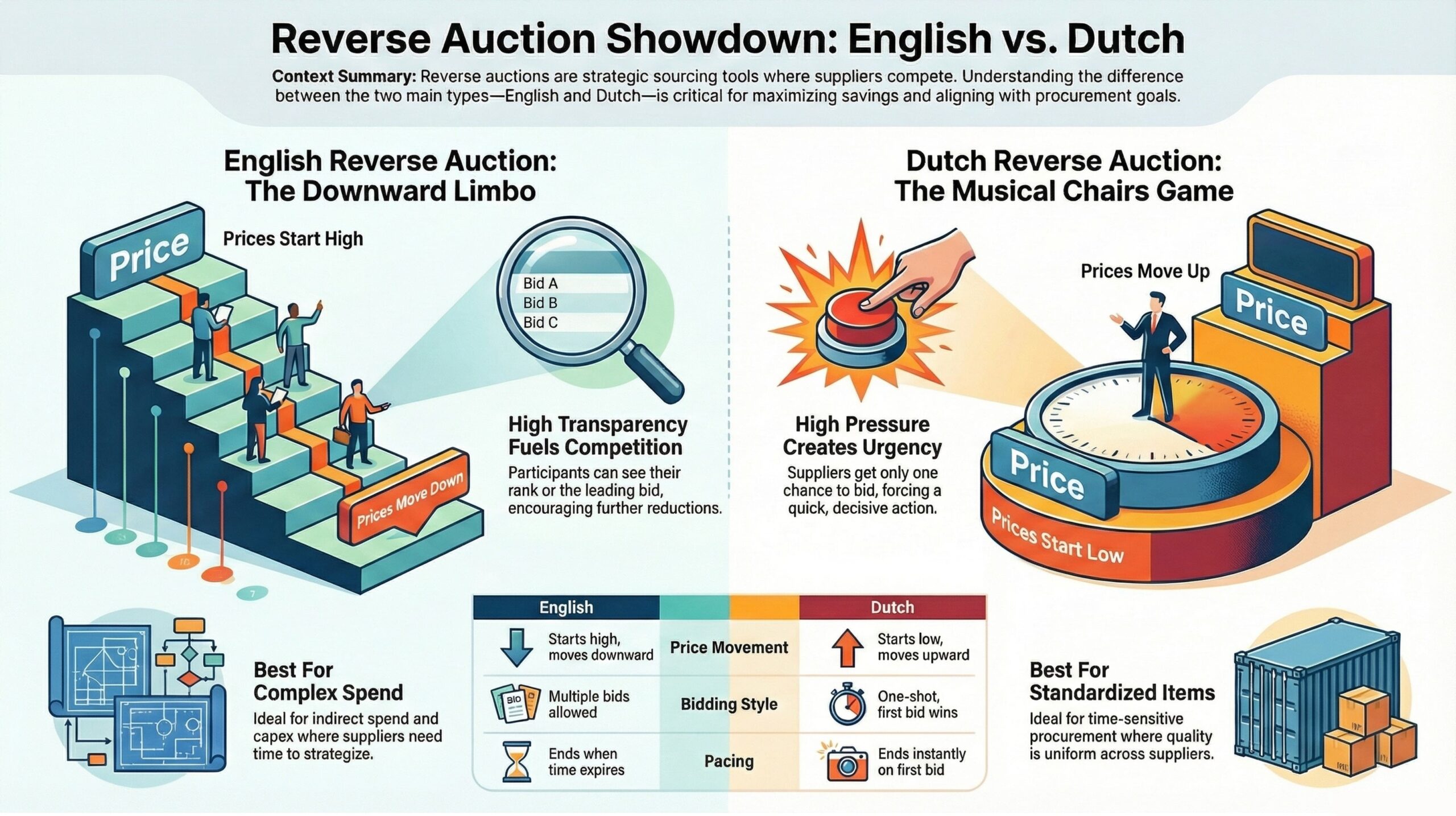
In this setup, suppliers enter the event at a price they find comfortable and progressively reduce their bids based on their competitive position. Suppliers can place as many bids as they want during the predetermined bidding period. Transparency is a hallmark of this style; participants can usually see their current rank or the leading bid, which fuels the competitive pressure.
When to Use It
This format can be used for various types of spend categories, best suited for indirect and capex. Because it allows suppliers enough time to read the competitive situation and reflect on their strategy, it is generally considered less stressful for participants.
Dutch Auctions: The High-Pressure “One-Shot”
A Dutch reverse auction operates on a completely different logic, tracing its roots back to 17th-century flower markets.
How it Works
The buyer establishes a starting “floor” price—which is almost always lower than the expected market price—and sets a specific time interval for price increments. As the timer counts down, the price gradually increases.
The moment a supplier finds the price acceptable and places a bid, the auction ends immediately. Unlike the English format, suppliers get only one chance to bid; if a competitor acts faster, the other suppliers lose the opportunity entirely.
When to Use It
Dutch auctions are ideal for standardized items where supplier quality is not the critical factor or for time-sensitive procurement. Because of the “one-shot” nature, this format applies maximum psychological pressure, requiring suppliers to be extremely focused to “take the prize” before someone else does.
Key Differences at a Glance
| Feature | English Reverse Auction | Dutch Reverse Auction |
|---|---|---|
| Price Movement | Prices start high and are pushed downward. | Prices start low and incrementally increase. |
| Bidding Opportunity | Suppliers can bid multiple times. | Suppliers get one chance to bid. |
| Transparency | High; suppliers see rank and/or best price. | Low; suppliers see price and a timer. |
| Completion | Ends when time expires and bids stop. | Ends instantly when the first bid is placed. |
Optimizing Your Auction Strategy
The choice between these two depends on your specific goals.
Closing the “Savings Gap”: In the English format, the leading supplier might stop reducing their price even if they could have gone lower, because no other supplier is pushing them further. A Dutch auction solves this gap by forcing suppliers to bid their lowest comfortable price immediately to avoid losing the deal to a faster competitor.
While the English format is excellent for transparency and ease of implementation, the Dutch format is a powerful tool for rapid decision-making in highly competitive markets. By understanding these dynamics, procurement teams can drive savings that often exceed 10% compared to previously negotiated prices.
Analogy for a better understanding
Here is an analogy for understanding the difference between English and Dutch formats of a Reverse Auction:
Think of an English reverse auction like a downward limbo contest, where participants keep going lower as long as they can stay in the game. In contrast, a Dutch reverse auction is like a game of musical chairs where the music is a rising price; the moment someone sits down (bids), the game is over instantly, and everyone else is left standing.